


Haihao Group Ships A105 WN Flanges with Inconel 625 Overlay to Singapore
Haihao Group has completed the production of a specialized A105 WN flange for a Singapore customer, combining an ASTM A105 carbon steel body with UNS N06625 (Inconel 625) weld overlay on the internal diameter and sealing face.
The order covers a 12-inch Class 150 weld neck flange with SCH 20 wall thickness, raised face (RF) configuration and ASME B16.5 dimensional requirements. Unlike a conventional carbon steel flange, this design places a corrosion-resistant nickel alloy layer directly on the surfaces exposed to the process medium and sealing environment.
Product Configuration
The supplied A105 WN flange is specified as:
|
Item |
Specification |
|
Flange Type |
Weld Neck, Raised Face (WN RF) |
|
Size |
12 inch |
|
Pressure Class |
ASME Class 150 |
|
Wall Thickness |
SCH 20 |
|
Base Material |
ASTM A105 |
|
Overlay Material |
UNS N06625 / Inconel 625 |
|
Overlay Thickness |
+3 mm |
|
Overlay Location |
Internal Diameter and Sealing Face |
|
Dimensional Standard |
ASME B16.5 |
|
Service Requirement |
NACE MR0175 |
|
Impact Test Temperature |
-29°C |
|
Impact Acceptance |
≥27 J |
|
Maximum Hardness |
187 HBW |
The combination is particularly relevant where the carbon steel forging provides the required structural strength while the process-facing surfaces need a higher level of corrosion resistance. Weld overlay is commonly used for this purpose because the corrosion-resistant alloy is deposited only where protection is required rather than manufacturing the complete flange from a nickel alloy.
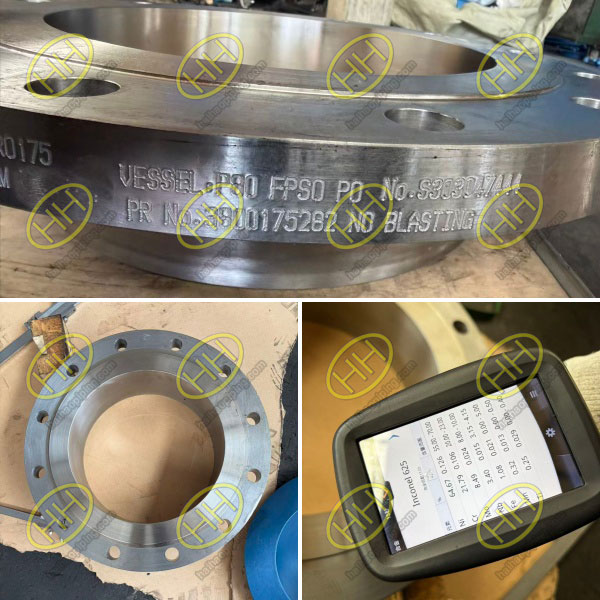
ASME B16.5 Class 150 A105 weld neck flange with UNS N06625 overlay
Why Use Inconel 625 Overlay on an A105 Flange?
ASTM A105 is widely used for forged carbon steel flanges, but the base material itself may not provide sufficient corrosion resistance for aggressive process environments. In this order, UNS N06625 was selected as the overlay material for the internal diameter and sealing face.
This arrangement gives the A105 WN flange two functional layers: the A105 forging provides the mechanical foundation, while the Inconel 625 overlay forms the corrosion-resistant surface.
The overlay area is also important. Instead of applying nickel alloy indiscriminately across the entire component, Haihao Group applied the specified weld overlay to the bore and sealing face, which are directly relevant to the customer’s service conditions and sealing performance.
For a raised-face flange, the sealing surface requires particular attention after welding because overlay deposition is followed by machining and dimensional verification. The final surface must retain the required flange geometry while maintaining the specified overlay thickness.
Manufacturing Control Beyond the Flange Dimensions
For this A105 WN flange, the inspection scope was not limited to checking the finished dimensions.
The customer required a complete documentation package covering the base material, overlay material and finished component. The supplied quality records include:
- Overlay material certificate
- Base material certificate
- Welding wire material certificate
- Welding wire retest report
- Penetrant testing (PT) report
- Ultrasonic testing (UT) report
- Final dimensional inspection report
- PMI / spectrochemical analysis report
- Overlay thickness measurement report
This documentation provides traceability from the original A105 forging and welding consumables through to the finished overlaid flange.
The weld overlay itself requires controlled deposition because the final performance depends not only on the alloy selected but also on the deposited layer, bonding condition, thickness and finished geometry. Industry practice for corrosion-resistant alloy overlays commonly combines welding qualification, non-destructive testing, PMI, hardness checks and dimensional inspection.
Low-Temperature and Hardness Requirements
Another important part of this Singapore order is the specified mechanical acceptance criteria.
The impact test temperature was -29°C, with an acceptance value of 27 J. The maximum permitted hardness was 187 HBW. In addition, the chemical composition limits for the carbon steel base material were specified as:
- C ≤ 0.23%
- S ≤ 0.020%
- P ≤ 0.025%
- CE ≤ 0.43%
These requirements make the material control more demanding than simply supplying a standard Class 150 flange. The base material chemistry, low-temperature impact performance and hardness must all be verified against the project requirements before the A105 WN flange is released.
For projects involving sour-service requirements, NACE MR0175 is also an important part of material and hardness control. However, the applicable acceptance basis should always follow the customer’s project specification and certification requirements rather than relying on the material name alone.
A Practical Approach to Corrosion-Resistant Flanges
The finished A105 WN flange illustrates a practical approach for pipeline systems where mechanical requirements and corrosion resistance need to be considered together.
A carbon steel forging such as ASTM A105 can provide the required flange body, while a 3 mm Inconel 625 overlay protects the specified process-contact surfaces. This makes the configuration suitable for projects where corrosion resistance is required at the bore and sealing interface without changing the entire component to a solid nickel-alloy construction.
For Haihao Group, orders of this type require coordination between forging, weld overlay, machining and inspection rather than treating the flange as a standard off-the-shelf component.
Customers looking for an A105 WN flange with nickel-alloy overlay can provide the flange size, pressure class, schedule, facing type, overlay alloy, overlay location, thickness and applicable service standard. Haihao Group can review the specification and prepare a manufacturing and inspection proposal accordingly.